Support beyond office hours
Students can access structured regulation tools when difficult moments happen outside counselling availability.
For high school wellbeing teams
Emotional regulation skills students can build by themselves. Ahfy helps high school students make better decisions when emotions take over.
The school wellbeing reality
Students need support before exams, after conflict, during lunch breaks, after school, and in the small moments before things become bigger. Ahfy gives students a calm, structured first step and teaches regulation skills they can practise independently, without adding another heavy program for staff to run.
The problem
Wellbeing teams are stretched thin, and students often only show up when they're already in crisis. Ahfy gives students a structured first step they can use independently, while helping teams see engagement trends and emerging themes before things escalate.
Students can access structured regulation tools when difficult moments happen outside counselling availability.
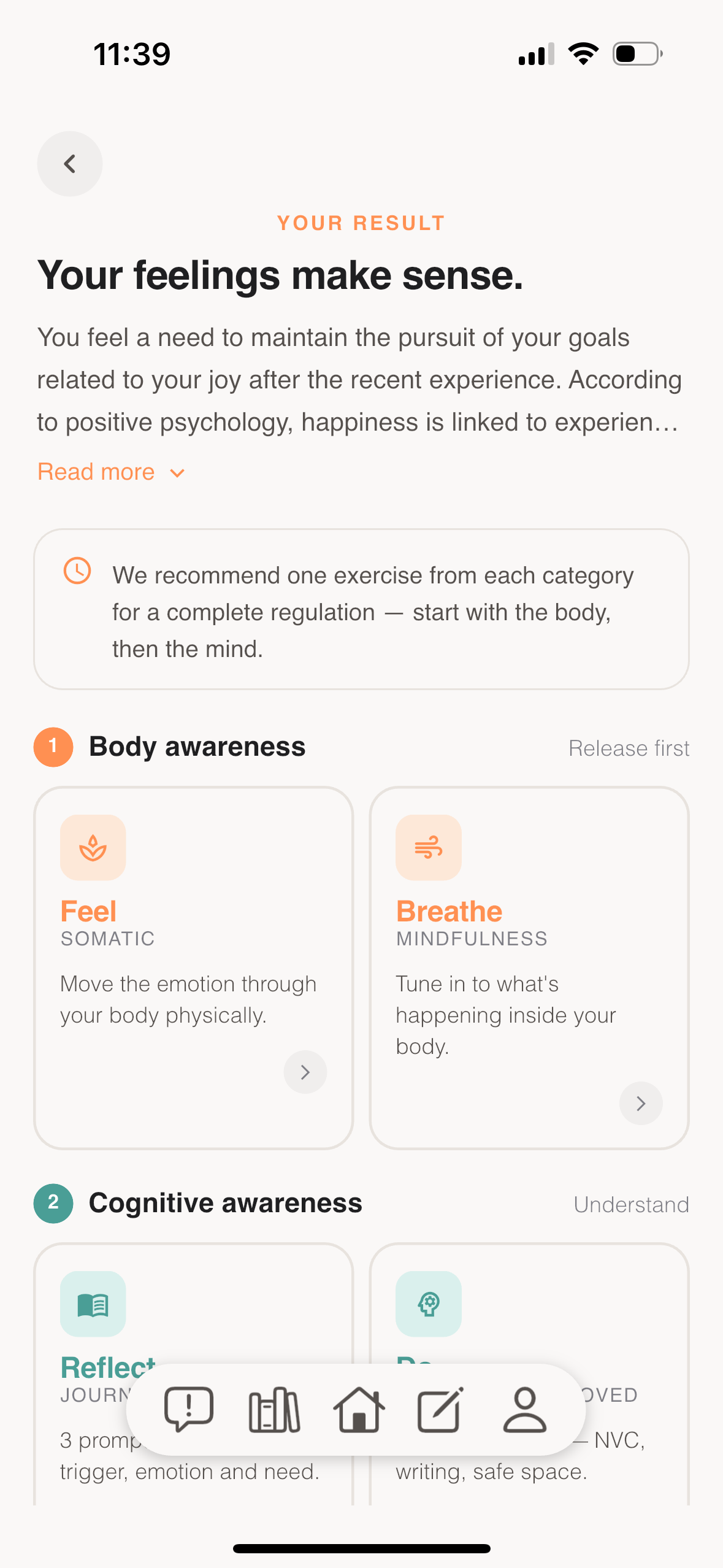
Students are guided through trigger, emotion, and need, then offered one of four exercise types they can use in the moment.
Ahfy helps students practise skills independently, while trained staff remain central to counselling, safeguarding, and follow-up.
Wellbeing teams can understand engagement trends and emerging themes before students only show up in crisis.
How Ahfy works
The experience is designed for real moments: when students are distressed, rushed, overwhelmed, or unsure how to explain what they feel.
Students start by naming the situation, trigger, emotion, and underlying need. They do not need the perfect words — Ahfy helps them find a starting point.
Ahfy offers therapist-informed exercises such as grounding, breathing, somatic tools, meditation, journaling, and short reflective prompts.
Daily check-ins, journaling, and progress views help students build emotional awareness over time, not just soothe one difficult moment.
The science behind it
Every part of Ahfy traces back to a named expert, a recognised framework, or a peer-reviewed body of work.
The way Ahfy helps students name what they feel is grounded in Ekman's foundational work on universal emotions and emotional granularity — not guesswork.
Body-based regulation exercises are drawn from Levine's research on how the nervous system holds and releases stress — moving beyond talk-only approaches.
Mindfulness content was created by a clinical psychologist with over 20 years of practice — exercises designed for real distress, not wellness marketing.
The Trigger → Emotion → Need framework at Ahfy's core was built by a licensed therapist — the same structured identification process used in real sessions, made accessible.
For schools
Students build skills independently, and trained staff remain responsible for counselling, safeguarding, and follow-up decisions.
Ahfy helps reduce the burden on wellbeing staff by providing students with tools to practise regulation before, between, and after conversations.
Ahfy teaches repeatable skills students can carry into exams, friendships, conflict, and life outside school.
Students can arrive with more language for what they feel, what happened, and what they may need.
Schools can understand feature use, engagement, and emotional themes across cohorts.
100+
exercises available
4
exercise categories
5
school teams consulted
It was a good way to reset my mind back to a calm state
Actually might be into journalling, helps to make the negative thought turn positive without much effort.
Was epic. couldn’t sleep. turning and tossing for 1.5hrs. did this, feel sleepy now and calm and not worried about tomorrow anymore :)
FAQ
No. Ahfy extends support between human touchpoints. It helps students regulate, reflect, and prepare for better conversations with trained staff.
No. Ahfy includes more than 100 exercises across four categories: therapist-approved exercises, somatic exercises, journal prompts, and mindfulness exercises.
The trigger-emotion-need framework was created by a licensed therapist. Emotion identification draws on Paul Ekman's work, mindfulness exercises were created by a mindfulness expert with 20+ years as a clinical psychologist, and somatic exercises are informed by Peter A. Levine's research. References to research foundations do not imply endorsement.
No. Ahfy is an emotional regulation and skill-building tool. It is not designed to diagnose, treat, replace counselling, or provide emergency care.
Ahfy can provide engagement trends, emotional themes, exercise use, and support signals that help teams plan resources and identify where follow-up may be needed.
The product direction is consent-first, minimal, role-based, and designed to protect student dignity. Sensitive data should be handled with restraint and clear access controls.
Ahfy uses a framework created by a licensed therapist, therapist-approved exercises, named research foundations, and validation from five high-school wellbeing teams.
We'll walk you through the student experience, the 100+ therapist-approved exercise library, school dashboard, privacy model, and how Ahfy could fit into your existing wellbeing pathway.